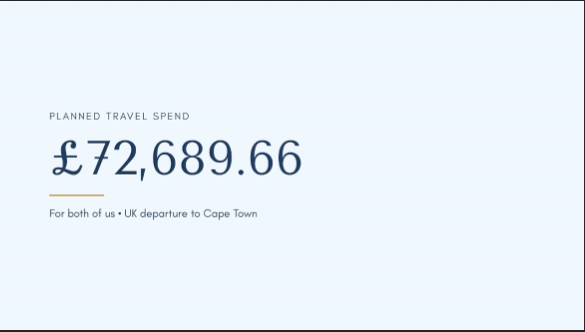
Our planned travel spend is £72,689.66 for two people. Here is where the money goes, what it does not cover and how we will keep the budget under control.
How much does it really cost to travel around the world for a year? It is the question people ask us most often, and the honest answer is uncomfortable because there is no single useful figure.
Our answer is £72,689.66. That is our planned travel spend for both of us from the day we leave the UK until we reach Cape Town. We have also put aside a separate £3,000 emergency fund that we hope never to touch.
It is a very large number. We are not pretending otherwise. Some people could make the same journey for far less, while others would spend much more. This is not a target for anyone else. It is the budget for the way James and Rob want to travel at 51 and 62.
What our £72,689 budget actually covers
The budget covers eleven countries and fifty five stops before we arrive at our Cape Town apartment. Our time in Cape Town is funded separately, so the headline figure is not the cost of every day of the full thirteen month period.
Our planned categories are:
- Everyday living and local transport: £26,106
- Travel between places: £16,921.17
- Accommodation: £14,601.75
- Activities, trips and tickets: £8,980
- Insurance, vaccinations and official costs: £4,380.74
- Medical supplies, toiletries and prescriptions: £900
- Clothing and replacement gear: £800
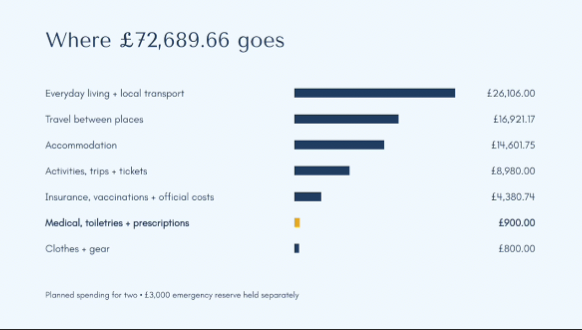
The most revealing point is that flights are not our largest expense. Ordinary life is. Food, groceries, coffee, tips, taxis, buses and local trains do not make dramatic photographs, but they happen day after day.
Why we have already spent more than £16,000
Before either suitcase leaves the house, more than £16,000 has already been paid. Seeing that figure in the spreadsheet felt alarming, but the money has not disappeared. It has secured important parts of the journey.
We have booked major flights, accommodation during Christmas and New Year, and experiences that could become unavailable if we waited. Machu Picchu is a good example. We will be in Cusco during Inti Raymi, when demand is high, so leaving essential arrangements until arrival would be a genuine risk.

Spending early is not automatically the same as spending more. In some cases it protects a reasonable price. It also gives us confidence that the difficult parts of the route are secure. The danger is paying for everything too soon and losing flexibility, so we have tried to lock in only the elements that matter most.
Everyday living is our biggest cost
We have allocated £26,106 to everyday living and local transport. This covers the routine costs of being in each destination rather than the major journeys between countries.
The same budget would not work everywhere. New Zealand and Japan are likely to cost more than Laos or Vietnam, so James has researched each country separately. We have chosen a comfortable middle level rather than applying one daily allowance across the entire journey.
We expect to cook regularly, particularly during longer stays. We also want to enjoy local meals, have a glass of wine and take a taxi when we are exhausted. A budget that forces us to reject everything enjoyable would look efficient on paper but would make the year miserable.
For travellers over 50, this is worth considering carefully. The cheapest possible option may carry a cost in energy, comfort or recovery time. Saving money matters, but so does building a routine that you can sustain for months.
Travel and accommodation reflect our priorities
Travel between places accounts for £16,921.17. Around £12,000 of that is for flights, with the rest covering trains, ferries, buses, vans, transfers and car hire.
With fifty five stops, smaller journeys accumulate quickly. We will not always choose the lowest fare. If a faster route saves an entire day and prevents another day of exhaustion, the extra cost may offer better value.
Accommodation is budgeted at £14,601.75. We are not staying in dormitories or choosing the cheapest room in a distant suburb. For longer stays we want private accommodation with space to cook, do laundry, edit videos and spend an occasional quiet day indoors.
Location matters too. A cheaper property can become poor value if we need taxis every day or spend hours reaching the places we want to visit. Our aim is comfort that supports the trip, not luxury for its own sake.

Experiences deserve their own budget
We have set aside £8,980 for activities, day trips and tickets. That is deliberate. There would be little point travelling so far and then refusing to pay for the experiences that brought us there.
This does not mean saying yes to everything. We have identified the experiences that matter most and booked the ones with limited availability. Less important activities can be decided locally once we understand our energy, the weather and the real state of the budget.
This is one of the most personal parts of travel planning. One person may value a special train journey, while another would rather spend the same money on a better apartment. A useful budget should reflect what you genuinely care about.
The costs that are easy to forget
Insurance, vaccinations, visas, prescriptions, toiletries and replacement clothing account for thousands of pounds. They are less exciting than flights or hotels, but leaving them out would make the headline figure misleading.
Travel insurance alone was planned at about £2,200, with vaccinations around £1,200. These are our personal figures, not general price guidance. Health needs, destinations, ages and policy terms will change the cost considerably, so anyone planning a similar journey should obtain current advice and quotations.
We also keep the £3,000 emergency fund completely separate. It is for genuine disruption, essential replacement purchases, extra accommodation or an urgent return to the UK. It is not permission to upgrade hotels because we have overspent elsewhere.
How the cost compares with staying at home
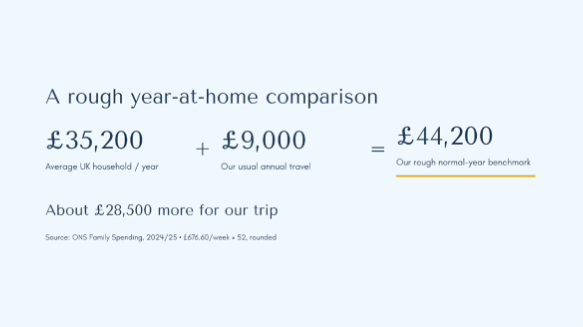
A large travel figure needs context. Staying in the UK for a year would not cost nothing. The Office for National Statistics reported average UK household expenditure of £676.60 a week for April 2024 to March 2025. That is about £35,200 over a year when rounded. We checked the published figure on 2 October 2026.
In a normal year we would also expect to spend roughly £9,000 on our usual holidays and a Cape Town trip. Combining that personal travel estimate with the national household average produces a rough benchmark of £44,200.
This is not a precise comparison. The national average is not our actual household spending, and our costs at home will not vanish completely while we are away. It simply shows why saying that the trip costs £72,689 more than normal life would be wrong. Against the rough benchmark, the difference is about £28,500.
How we will manage the budget on the road
We will record spending every day and compare the running total with the plan. One expensive meal or one costly country will not cause panic. We are looking for a continuing pattern rather than reacting to isolated days.
If spending remains too high, we can cook more often, reduce later accommodation costs or reconsider activities that matter less. The emergency fund will not cover ordinary overspending.
The spreadsheet is there to support decisions, not to make us feel guilty whenever we buy coffee. We will share the real figures as we travel, including where the plan was accurate and where it failed.
Our honest verdict
£72,689.66 is a substantial amount of money, but it represents a conscious choice. We have saved for this journey and planned it around the comfort, pace and experiences that matter to us.
You can watch our full round the world budget video to see how James and Rob built the figures and why the total is already changing before departure.
The most useful question is not how cheaply somebody else can travel for a year. It is what your version of a long journey would cost, including the ordinary days, the less visible expenses and the level of comfort you need to keep enjoying it.