Why James’s application was refused, how we responded, and what other couples can learn from our South African permanent residency experience.
When Rob’s South African permanent residency was approved, we expected James’s decision to follow. We applied as a couple, submitted a substantial collection of evidence and had built our plans around being able to spend longer periods together in South Africa.
Instead, only one of us was approved.
James received an email saying that a decision had been made, but it did not reveal the outcome. He then had to travel to the VFS office in London to collect a single sheet of paper. After a six hour return journey, the answer inside the envelope was a refusal.
It was disappointing, confusing and immediately disruptive. It also left us with very little time to decide what to do next.
This is our personal experience rather than immigration advice. Rules and procedures can change, and individual cases differ, so anyone making an application should check current official guidance and consider professional advice.
The same future, but two different decisions
Our goal was straightforward. South Africa is an important part of our future, whether as a second home, a place for longer stays or somewhere we may spend more time during retirement.
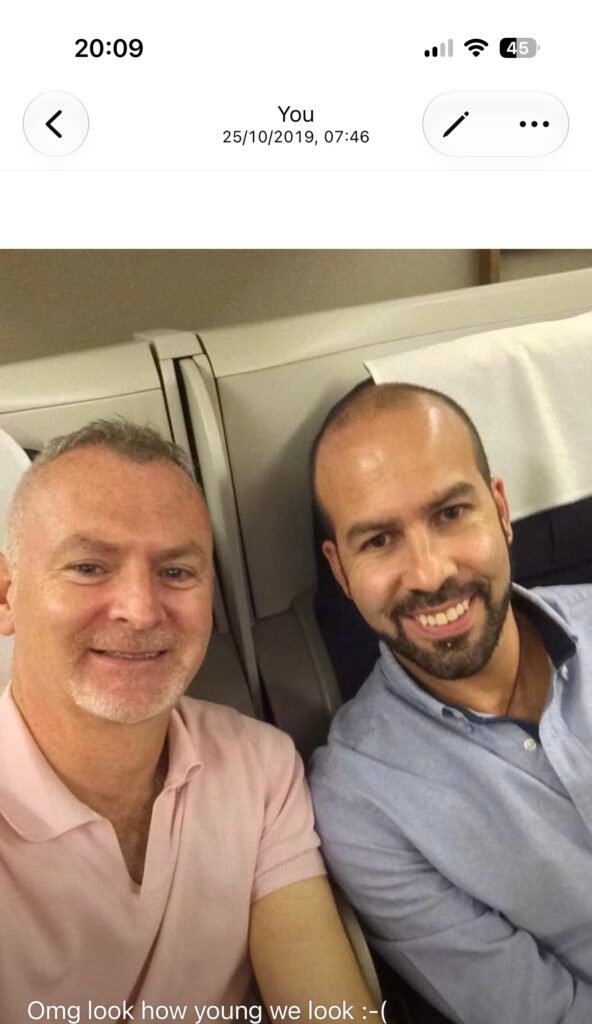
Rob applied under the financially independent route, with James included as his partner. We supplied evidence of our shared life going back to 2011. That included financial information, travel records, proof that we had lived together, photographs and affidavits from five friends.
We also included our marriage certificate. We married in April 2025, but our relationship had already existed for many years. To us, the certificate was simply further evidence of the life we had already documented.
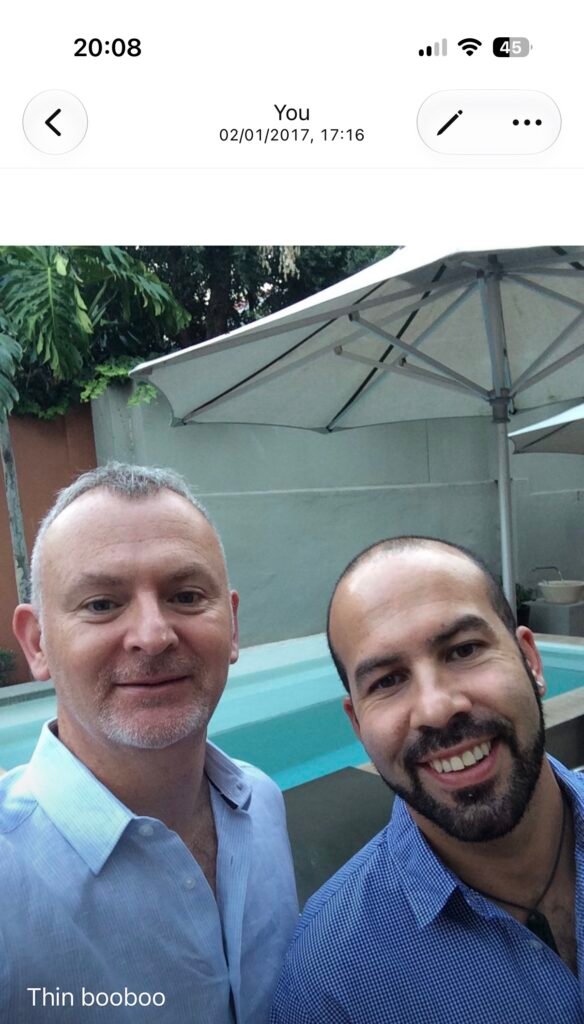
Rob’s application was approved. James’s was not. The contrast was difficult to understand because the two applications were connected to the same relationship and the same future plans.
What the refusal appeared to focus on
Our reading of the refusal was that the decision focused on the date of our marriage. Because we had been married for only about a year, the application was treated as though the relationship did not meet the required period.
What frustrated us was the amount of other evidence that seemed not to have influenced the result. We had documented our relationship from 2011 to the application in 2024. The marriage certificate was one item in a much larger file, yet it appeared to have become the central issue.
We cannot know exactly how every page was assessed, and we do not want to pretend that we can. What we can say is that the refusal did not appear to reflect the full history we had supplied.
That distinction matters for couples whose legal marriage is more recent than their relationship. A certificate records the date of a marriage, not necessarily the beginning of a shared life.
Ten working days to respond
The refusal created an immediate deadline. James had 10 working days from receiving the decision to submit an appeal. We checked the current South African Immigration Act on 11 September 2026, and section 8 provides 10 working days from receipt of notification for an aggrieved applicant to seek review or appeal through the prescribed process.
James was also about to travel for work, which meant we had roughly 48 hours together to prepare. There was no time to sit with the disappointment. We needed to return to the evidence, decide how to present it and make sure nothing important was missing.
This was where careful record keeping saved us. We had scanned every page of the original submission and kept the files in an organised form. Without those copies, rebuilding years of evidence at short notice would have been far harder.
How we prepared the appeal
We resubmitted the relationship evidence and made the chronology much more explicit. Photographs carried dates. The covering explanation stated clearly that our marriage certificate supported the application but did not define the length of our relationship.
We placed the certificate later in the pack so it could not dominate the story. The documents showing our life from 2011 came first and were arranged to make the timeline easy to follow.
There is a practical lesson here. A large file is not necessarily a clear file. Evidence should guide the person reading it from one conclusion to the next. Dates, section labels and a concise covering explanation can matter as much as the number of pages.
We would also recommend keeping both digital and paper copies of everything. Store the decision letter, emails, appointment details, receipts and every page submitted. When a deadline is short, good organisation becomes more than a convenience.
Submitting the appeal through VFS London
We emailed VFS and were told to attend during a particular period. When we arrived, the staff initially gave us a different entry time, but showing the email resolved the problem. Keeping written instructions accessible on your phone can prevent a stressful conversation at the door.
Once inside, the actual handover was quick. The more difficult part was establishing what proof we would receive. We were told there would be no separate appeal reference number or online tracking facility for our submission.
We asked for written confirmation, kept the email chain and photographed the stamped first page. We wanted clear evidence that the appeal had been lodged within the deadline.
Our experience should not be treated as a universal description of every VFS office or application. Procedures can vary. The useful principle is simple: before leaving, obtain the strongest confirmation available that your documents were accepted.
The difficult part is waiting
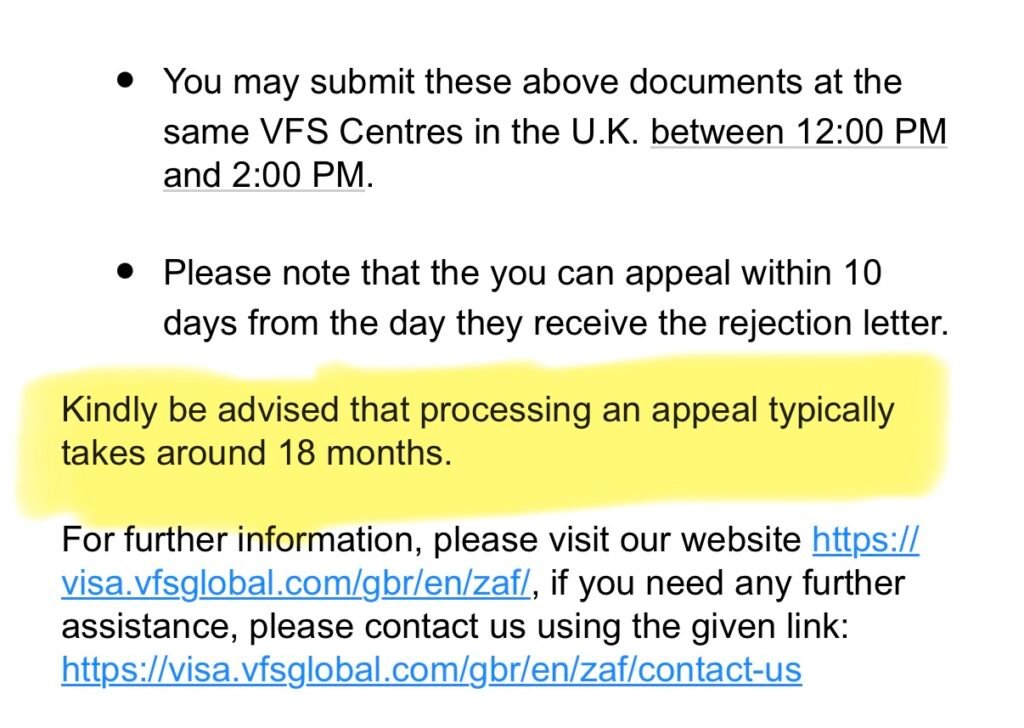
The VFS email advised us that processing an appeal typically takes around 18 months. That is not a guaranteed timescale, but it gives us an idea of the patience required.
With no tracking number, there is little sense of progress. The documents move through the system and we wait for an eventual decision. For two people trying to plan travel, retirement and time in South Africa, that uncertainty is not a small matter.
It affects how long we may be able to stay together in the country and whether another temporary visa route becomes necessary. Plans that once felt settled now need alternatives.
Why Rob must return to South Africa
Rob’s approval created a separate practical issue. His permit requires him to enter South Africa within the period stated in his documentation. For Rob, that deadline is 20 May 2027.
Our wider travel plans did not originally put us in South Africa before then, so Rob arranged an additional trip to Cape Town. That means extra travel and accommodation, but missing the deadline is not a risk we are willing to take.
We are checking the correct arrival process directly before travelling rather than relying on assumptions. Anyone activating a permit should do the same, using the conditions on their own documents and current official advice.
What we would tell another couple
First, make the relationship timeline impossible to miss. Do not assume that a marriage certificate or a thick bundle of evidence tells the full story on its own.
Second, scan every page before submission. Keep copies in more than one secure place and use filenames that make sense when you are under pressure.
Third, note the exact date on which a decision was received. Appeal periods can be short, and the deadline may begin immediately.
Fourth, keep written proof of instructions and submission. Emails, stamps and receipts can become important when there is no convenient tracking system.
Finally, build alternatives into your plans. An appeal may succeed, but it may also take a long time or produce another refusal. A temporary visa or a later application may offer another route, although professional advice is sensible before choosing one.
Our honest verdict
The process has left us frustrated. We spent a great deal of time building what we believed was a clear record of our relationship, only to receive a decision that seemed to focus on one recent document.
Even so, this is not the end of our South African plans. James’s appeal has been submitted, Rob will complete the requirements attached to his own approval, and we will keep reviewing the options available to us.
You can watch our full permanent residency update on YouTube to hear more about the refusal, the appeal submission and what happens next.
Our feelings are mixed. South Africa still matters enormously to us, but the residency process has been slower, less transparent and more emotionally demanding than we expected. For anyone considering a similar path after 50, our advice is to prepare carefully, keep every record and make room in your plans for uncertainty.
We hope the appeal eventually produces a fair outcome. Until then, we wait, adapt and continue planning a future that still includes South Africa.